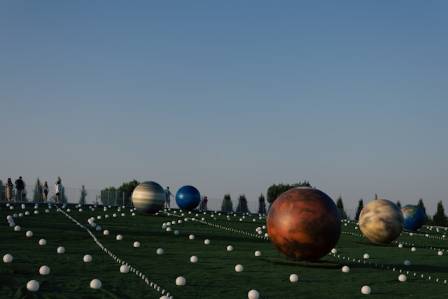

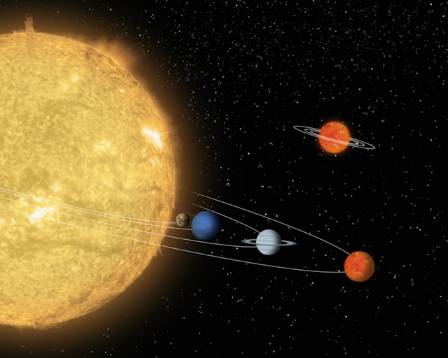
Stretching the full length of Sweden, the Sweden Solar System holds the title of the world’s largest planetary system model, crafted at a 1:20 million scale. At its center stands Stockholm’s Ericsson Globe— the planet’s largest spherical structure—representing the Sun, complete with a scaled depiction of its corona. The planets are strategically positioned and sized to match this ratio: inner planets cluster around Stockholm, while Jupiter resides at Arlanda International Airport. Continuing northward, Saturn awaits in Uppsala, Pluto rests in Delsbo (300 km from the Globe), and the model culminates at the Termination Shock, a staggering 950 km from the “Sun.”
Each planetary station features interactive exhibits blending astronomical and natural science insights with stories from mythology and culture. The project initially garnered support from the Stockholm Visitor’s Board (formerly the Stockholm Information Service), alongside numerous museums, theaters, parks, and scientific institutions.
Key Details of the Planetary Installations
-
Sun (Ericsson Globe, Stockholm): Boasting a 110-meter diameter, this iconic structure doubles as the model’s Sun, with its design incorporating the solar corona to honor the scale.
-
Mercury: A 25-cm diameter model located at Stockholm City Museum, 2.9 km from the Globe.
-
Venus: Two iterations exist: a 62-cm model by U.S. artist Daniel Oberti (inaugurated during the 2004 Venus transit, later shattered in 2011) at KTH Royal Institute of Technology (5.5 km from the Globe), and a replacement at the Observatory Museum.
-
Earth: A 65-cm model situated at the Swedish Museum of Natural History’s Cosmonova, 7.6 km from the Globe, complemented by satellite image exhibits near the Ericsson Globe.
-
Moon: An intricate 18-cm model displayed in a separate section of the Swedish Museum of Natural History.
-
Mars: A 35-cm copper sculpture by Finnish artist Heikki Haapanen at Mörby Centrum (a Danderyd shopping center, 11.6 km from the Globe). It features an “umbilical cord” connecting to an Earth-imagined steel plate and markings for typical Martian chemical elements.
-
Jupiter: A 7.3-meter diameter floral installation at Arlanda Airport’s Sky City roundabout (40 km from the Globe), with different flowers symbolizing the gas giant’s distinct zones—though plans for a 3D replacement are underway.
-
Saturn: A 6.1-meter model outside Uppsala’s historic Anders Celsius Observatory, located in Celsius Square (73 km from the Globe).
-
Uranus: Following vandalism of the original, a new 2.6-meter model is planned for Gävle, 143 km from the Globe.
-
Neptune: A 2.5-meter acrylic sculpture along Söderhamnsån River in Söderhamn (229 km from the Globe), a coastal town with fishing and sailing traditions that echo Neptune’s role as the sea deity. It illuminates with blue light after dark.
-
Pluto & Charon: A 12-cm Pluto model and its moon Charon stand near Delsbo’s southern Dellen lakes (300 km from the Globe), formed by a 90-million-year-old meteorite impact. The sculptures rest on gravel-like pillars made of dellenite—a rare local mineral from the impact—paying homage to Pluto’s mythological association with the underworld.
-
Termination Shock: Marking the heliosphere’s edge (where solar wind slows from supersonic speeds), a foundation for a future sculpture exists at the Institute of Space Physics in Kiruna (950 km from the Globe, above the Arctic Circle), though no installation is yet in place.