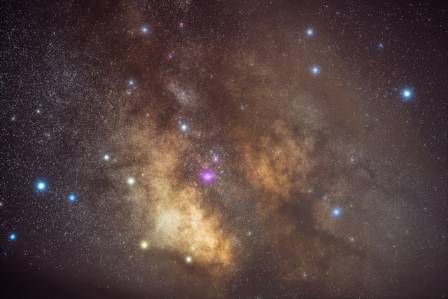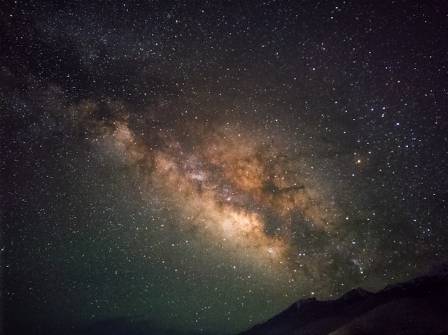
Did you know that our Sun is just one among hundreds of billions of stars drifting through an enormous structure in space called the Milky Way Galaxy? The Milky Way is an immense system made up of stars, gas, and cosmic dust. It’s known as a spiral galaxy because, if viewed from above or below, it would resemble a spinning pinwheel. Our Sun is positioned on one of the spiral arms, about 25,000 light-years from the galaxy's center. Even if you could travel at the speed of light (300,000 kilometers or 186,000 miles per second), the journey to the center would take around 25,000 years.
If we could step outside our galaxy and look back, it might appear as a vast spiral, like this artist’s interpretation based on astronomical data.
The name "Milky Way" comes from an ancient Greek legend about the goddess Hera, who supposedly spilled milk across the heavens. In other cultures, the galaxy has different names. In China, it’s known as the “Silver River,” while in the Kalahari Desert of Southern Africa, it's referred to as the “Backbone of Night.”
From Earth, you can see the Milky Way stretching across the night sky. Have you ever spotted it on a clear evening?
If we could look at our galaxy from the side, it would resemble a massive, thin disk with a slight bulge in the center. This flat appearance is a result of the galaxy rotating. Without gravity holding everything together, all of its contents would scatter into space.
Seen from the side, the Milky Way looks like a gigantic disc with a thick center—like a pancake with a bump!
Without using a telescope, we can spot roughly 6,000 stars from Earth. While that might sound like a huge number, it’s only a tiny fraction of the entire galaxy. Imagine the Milky Way as a giant pepperoni pizza—the stars visible from Earth would fit within just one pepperoni! For every star we see, there are more than 20 million that remain invisible—hidden by distance, dimness, or cosmic dust.
Just one slice of the cosmic pizza! Most of the stars in the galaxy can’t be seen without special instruments.
Q&A with Astronomer Julianne Dalcanton
Are all galaxies like the Milky Way?
Not exactly. Galaxies vary in both size and shape. Smaller galaxies might contain only millions of stars, while larger ones can have billions. There are different types too: some are spiral galaxies like the Milky Way, others are elliptical galaxies (which look like glowing ovals), and the rest are called irregular galaxies because of their unusual shapes.
Some galaxies spin like pinwheels, others are more rounded or have no clear structure at all.
Do you have a favorite galaxy?
I really like the Sombrero Galaxy because it gives a strong sense of how three-dimensional galaxies truly are. Most galaxies look like flat pictures in the sky, but the Sombrero looks like a real object floating out in space!
The Sombrero Galaxy stands out with its bright halo and central bulge—like a hat in space!
Is being an astronomer fun?
Absolutely! I get to visit fascinating places like Hawaii and Chile, where the world’s most powerful telescopes are located—on remote mountaintops where the air is dry and the skies are clear. When I’m observing stars through the night, I sometimes play music to help stay awake!
Mountaintop observatories are perfect for stargazing, far away from city lights and pollution.