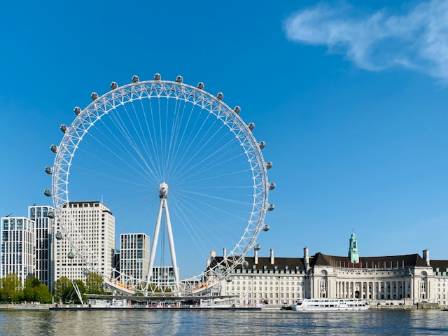
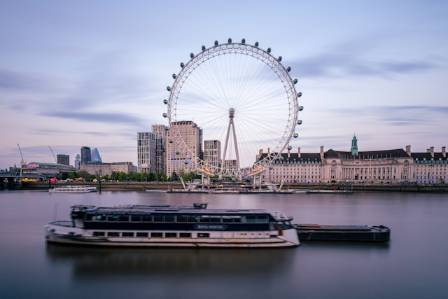
As the sun dips over the Thames, casting golden light across London’s skyline, one structure stands out—its gilded rim glinting, its slow rotation a quiet dance against the city’s bustle. The London Eye, at 135 meters tall, is more than a ride; it is a symbol of modernity, a masterclass in engineering, and Britain’s single most visited tourist attraction. Born from a simple idea—to reimagine the Ferris wheel as a tool for observation—it has transcended its original purpose to become an enduring icon of the 21st century.
From Ferris to “Eye”: The Evolution of a Concept
The story of the London Eye begins over a century earlier, in 1893, with a man named George Ferris. Tasked with creating a structure to rival the Eiffel Tower (the star of the 1889 Paris Exposition) for Chicago’s World Columbian Exposition, Ferris, an American engineer, designed a steel behemoth: a 80.4-meter wheel with 36 wooden cars, each holding 60 passengers, rotating on a 45-ton axle. It was a triumph of 19th-century engineering, built to showcase America’s industrial might. Though Ferris’s creation was dismantled after the fair, his name became synonymous with the concept—“Ferris wheel”—and sparked a global craze.
For decades, Ferris wheels remained fixtures of carnivals and fairs: temporary, whimsical, and focused on thrill over perspective. They were rides, not landmarks. That changed in the late 1990s, when British architects David Marks and Julia Barfield proposed a radical reinvention. Commissioned as part of London’s millennium celebrations, their vision was not a fairground attraction but an “observation wheel”—a stationary structure designed to offer unrivaled views of the city. The London Eye, as it would be named, was to be a monument to the new century, blending art and engineering.
Engineering Elegance: The Making of the London Eye
What sets the London Eye apart is its structural audacity. Unlike traditional Ferris wheels, which are supported on both sides, it cantilevers outward from a single A-frame support, anchored to the ground on the banks of the Thames. This design, inspired by a bicycle wheel, features a thin rim of 32 sealed, air-conditioned capsules (one for each borough of London), connected to a central hub by steel spokes. It is a study in minimalism: elegant, almost weightless, yet capable of withstanding gale-force winds.
Building it was a logistical feat. The wheel’s components were crafted across Europe: the hub in the Netherlands, the spokes in Germany, the capsules in France. These massive parts—including the 2,100-ton rim—were transported by barge up the Thames to Jubilee Gardens, near Waterloo Station, where they were assembled horizontally on temporary supports. In October 1999, after months of precision work, the wheel was slowly lifted into its vertical position using hydraulic jacks—a 16-hour operation watched by crowds.
The result is a marvel of slow motion. The Eye rotates at a barely perceptible 0.9 km/h, taking 30 minutes to complete a full turn. It carries up to 800 passengers at once, each capsule offering 360-degree views. On clear days, visibility stretches 40 kilometers: from the dome of St. Paul’s Cathedral to the towers of Canary Wharf, and even as far as Windsor Castle, 32 kilometers west.
From Temporary to Timeless: A Millennium Success Story
The London Eye was never meant to be permanent. Conceived as a temporary millennium attraction, it was granted a five-year permit. But its popularity was immediate. By 2002, it had welcomed over 8 million visitors, outperforming even the Tower of London. Local authorities extended its stay, and in 2005, it was made a permanent fixture.
Today, it draws 3.5 million visitors annually, more than any other paid attraction in Britain. Its success lies in its versatility: it is a tourist must-see, a backdrop for New Year’s Eve fireworks, a venue for charity events, and even a spot for marriage proposals. During the COVID-19 pandemic, it served as a beacon of resilience, lit up in messages of hope.
Its impact on London’s tourism industry is profound. Tourism is one of Britain’s largest economic drivers, contributing over £125 billion to the economy in 2013 and supporting 3 million jobs—making it the country’s third-largest source of employment. The London Eye, alongside landmarks like Big Ben and the British Museum, anchors this sector, drawing visitors from across the globe and boosting spending in hotels, restaurants, and shops.
A Global Legacy
The London Eye’s success has sparked a new era of “observation wheels.” From the Singapore Flyer (165 meters) to the High Roller in Las Vegas (167.6 meters), cities worldwide have embraced the concept, each aiming to outdo the last in height and innovation. But none have matched the London Eye’s cultural resonance. It is more than a wheel; it is a symbol of London’s ability to blend tradition and modernity, to honor its past while reaching for the sky.
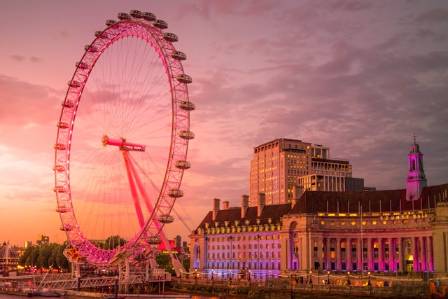
As dusk falls and the Eye’s capsules light up like lanterns, it is easy to see why. George Ferris’s 1893 invention was a celebration of engineering. The London Eye, a century later, is a celebration of perspective—of seeing a city, and a world, in a new way.