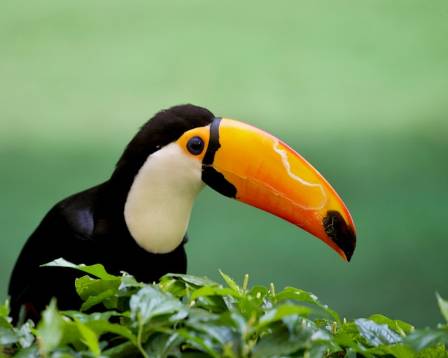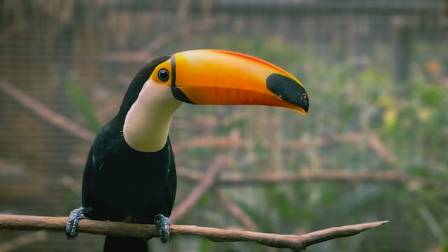
The Toco Toucan, scientifically identified as Ramphastos toco, is the most recognizable member of the Ramphastidae family. Known for its strikingly large beak, this avian species belongs to the order Piciformes and is found across several South American nations, including Brazil, Argentina, and Peru. These birds primarily inhabit tropical rainforests, where they play a vital role in the local ecology as omnivores.
Physical Traits and Biological Overview
Toco Toucans are distinguished by their dark bodies contrasted by a white chest and vibrant orange skin surrounding the eyes. They can reach a total length of approximately 62.5 centimeters, with their iconic bills accounting for nearly 19 centimeters of that size. Despite their substantial appearance, they are relatively light, weighing about 600 grams. Their diet is varied; while they mostly consume fruit, they also eat insects, small reptiles, and the eggs of other birds. They reach maturity between three and four years of age and can live for up to two decades.
Reproduction and Development
The breeding cycle of the Toco Toucan begins with an incubation period lasting between 16 and 20 days. A typical clutch consists of two to four eggs. Once the chicks hatch, they remain in the nest for eight to nine weeks before they are ready to fledge. Interestingly, these birds often utilize pre-existing cavities for nesting, such as hollowed-out sections of trees or abandoned woodpecker nests.
Distinctive Features and Behaviors
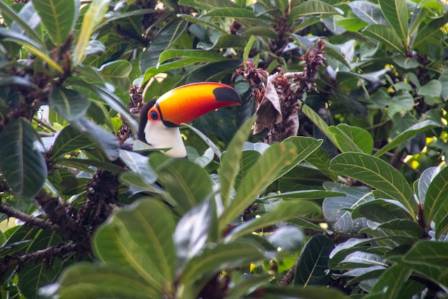
The massive beak of the toucan is a marvel of biological engineering. Although it looks heavy, it is actually quite lightweight and porous, composed of the protein keratin and supported by thin bony struts—giving it a texture similar to a firm sponge. This bill likely serves multiple purposes, including defense and mating rituals. During sleep, the toucan tucks its beak under its wing and folds its tail forward, transforming into a compact ball of feathers.
In their natural environment, Toco Toucans are often more mobile by hopping than by flying, as they are not particularly strong long-distance fliers. They are also known for their vocalizations; their deep, frog-like croaking can be heard from over half a mile away through the dense jungle canopy. Their tongues are uniquely shaped like feathers, helping them manipulate food effectively.
Cultural Significance and Folklore
Toco Toucans hold deep symbolic meaning for many indigenous groups in Central and South America. In some traditions, they are associated with the supernatural and are believed to be vessels for spirits. Certain tribal customs dictate that the fathers of newborns avoid eating toucan meat to prevent spiritual harm to the child. Additionally, these birds have served as totems for various tribes, and traditional healers have historically viewed them as guides for spiritual journeys.
Environmental Status and Preservation Efforts
Currently, the Toco Toucan is categorized as a species of "Least Concern" by the IUCN, with a global population estimated to exceed 10,000 adults. However, their numbers are on a downward trend. The primary threats to their survival include significant habitat loss caused by widespread clearing of forests and hunting pressures. They are frequently targeted for their colorful feathers, for food, or to be sold into the exotic pet trade. Efforts to protect these birds focus on curbing deforestation and regulating the capture of wild individuals for commercial purposes.